
A student cumulative file, an attendance register and a transfer certificate do not impose the same demands on a PVC file. By matching the record size, sheet volume, construction, closure and printing brief, you can specify files that protect documents without wasting space or splitting at the seams.
Key takeaways
- Specify about 240 × 320 mm of usable internal area for A4 records.
- Measure the largest document before choosing PVC file sizes in Nagpur.
- Calculate spine width from sheet count, dividers and document sleeves.
- Test closures, welds, printing and material thickness before placing a school order.
Match each school record to its actual sheet size
ISO A4 sheets measure 210 × 297 mm, but an A4 label does not guarantee enough filing room. Specify about 240 × 320 mm of usable internal area, then check clearance for dividers, punched holes, laminated certificates and document sleeves without folding. Measure your largest existing document before comparing PVC file sizes in Nagpur.
| Record series | Recommended format | Reason |
|---|---|---|
| Student cumulative files | A4, 240 × 320 mm internal area | Holds correspondence, assessment sheets, report cards and dividers |
| Admission documents | A4 | Suits applications, identity copies and office forms |
| Examination records | A4 | Fits mark sheets, results and assessment documents |
| Attendance and fee records | A4 or gusseted A4 | Accommodates registers, receipts and repeated additions |
| Staff files | A4; foolscap if legacy forms extend beyond 297 mm | Prevents oversized service documents from bending |
Use foolscap or long-file formats for legacy registers, government forms, transfer certificates and ledger sheets that extend beyond 297 mm. A 30–40 mm gusset helps bulky files, but verify the largest sheet and pocket dimensions first.
Choose opaque or translucent PVC for student names, photographs, medical information and marks. Add a clear front label pocket instead of exposing the whole file.
The question “which pvc file for specifications suit schools in nagpur” is answered by the record, not the catalogue name. One universal size wastes space in small series and bends documents in larger ones. Compare pvc file sizes in nagpur only after measuring actual records.
Set spine width and capacity from the sheet count
A flat PVC folder suits a thin packet, not a 300–500-sheet record. At 80 gsm, those sheets occupy roughly 30–50 mm before dividers, sleeves and distortion, so choose a 30–40 mm gusset, box-style file, expanding file or ring-binder format instead.
For repeatedly handled A4 records, 25–40 mm is a versatile spine or gusset range. Match PVC thickness to handling, not to a vague “heavy duty” label: 0.30–0.40 mm suits short-term issue folders, 0.50–0.70 mm suits student and office files, and 0.80–1.00 mm suits rigid inspection files or upright storage.
Do not buy on a promised page count. Construction, punched sheets and inserts change the usable capacity. Use this acceptance procedure:
- Fill a sample with the intended sheets, dividers, sleeves and laminated documents.
- Close it fully and reject it if the cover bows, the fastener strains or the gusset pulls open.
- Turn the pages. They must move freely without catching on the spine, eyelets or corners.
- Remove the loaded file from a shelf, carry it, and return it several times.
- Inspect whether the spine, eyelets and corners remain flat.
Overfilling causes failure before the PVC sheet splits. A distorted cover transfers force to the hinge, weld, punched holes, snap and corners, reducing the service life of durable PVC files for schools.
Compare file constructions, closures and material details
Choose the construction from the record’s handling pattern, not from the label “A4 PVC file.”
| Format | Suitable use | Where it fails |
|---|---|---|
| Flat PVC folder | Thin packets issued frequently, such as permission slips | Multi-year cumulative files bow and split at the spine |
| Clip file | Loose sheets needing rapid access | Punches tear, and bulky records cannot lie flat |
| Ring-binder | Dividers, additions and rearranged student records | Needs reinforced holes, compatible rings and shelf space |
| Expanding file | Multiple categories and records that keep growing | Less convenient for single-sheet daily circulation |
| Box file | Thick contents stored upright | Heavier to carry and slower to access |
| Simple document folder | Short-term distribution | Poor choice for archival retention |
Use a zip when loose papers must stay contained; specify a strong welded or stitched seam because a weak zipper edge opens first. Press buttons and snaps open quickly but concentrate force around the fastener. Elastic gives fast access but loses tension. A flap protects document edges while leaving an entry path for dust.
For routine school use, specify opaque PVC, 0.50–0.70 mm with a stated thickness tolerance. Request a folded or welded spine, rounded corners, reinforced punched holes or metal eyelets, the exact hole number and pitch, a replaceable label pocket, and a handle only when carrying requires it. A 0.25–0.35 mm cover suits short-term issue folders.
PVC is not automatically moisture-proof in Nagpur’s monsoon humidity. Seams, holes, zippers and flap edges remain vulnerable; insert dry records and avoid damp walls or unventilated cupboards.
Build a procurement test for school use and retention
A school tender becomes testable when it replaces “A4 PVC file” and “heavy duty” with measured dimensions, materials and a loaded sample.
| Field | Purchase specification |
|---|---|
| Finished cover | State closed length and width in millimetres |
| Maximum sheet | Name the largest sheet, such as A4, foolscap or legal |
| Usable pocket | Minimum internal area, such as 240 × 320 mm for A4 |
| PVC | Type, nominal thickness and tolerance, such as 0.60 mm ± 0.05 mm |
| Spine or gusset | State width, such as 30 mm, and whether it is folded or welded |
| Capacity | Intended sheet count, including dividers, sleeves and laminated records |
| Closure | Name the zip, press button, snap, elastic or flap |
| Eyelets | State metal or high-strength plastic and reinforcement method |
| Hole pitch | State hole number and centre-to-centre spacing in millimetres |
| Corners | State the corner radius, such as 8 mm, and require rounded edges |
| Label | State pocket size, insert size and replaceable label format |
| Packing | State files per carton, inner pack and carton identification |
Require one production sample loaded to its stated capacity. Open it repeatedly, carry it by the normal handle or body, and remove it from a shelf several times; reject seam tearing, cracked corners, bent covers, distorted closures or loose eyelets.
Insert only dry records. In Nagpur, keep files away from damp walls and store them in ventilated cupboards; sealed storage traps humidity.
PVC suits routine handling, not records retained for decades. For permanent or historically important records, specify acid-free folders, polyester or polypropylene sleeves, or another preservation-approved material. A sample that looks attractive but lacks these measurements and tests proves very little.
Turn the specification into a print-ready Nagpur order
A print-ready order turns custom PVC file specifications into measurable artwork, production and inspection instructions, rather than leaving a printer to interpret “A4 file” or “heavy duty PVC.”
1. State the finished file and usable internal size, bleed, safe area, printed sides, colour count, white-ink requirement, barcode or QR-code dimensions, variable-data fields, writable areas and packing quantity. Identify whether the file is opaque or clear, and whether student names, department names, photographs or several designs will change between copies.
2. Select the print process by job pattern. Use screen printing for repeated runs with a small number of solid colours. Use UV digital printing for short runs, variable names, photographs and multiple designs. On clear PVC, request a white underprint beneath CMYK artwork when colours must remain opaque and high contrast.
3. Specify an opaque 0.50–0.70 mm PVC file in verified A4 or legacy format. Add a 30–40 mm gusset for bulky records, reinforced holes, rounded corners and a replaceable spine label. Confirm every dimension with the largest document, not its nominal size.
4. Approve an actual PVC production sample, never paper artwork alone. Test dry-rub, wet-rub, tape-pull adhesion, flexing across the print, spine scuffing, closure abrasion and barcode legibility.
These details help you compare PVC file printing services in Nagpur on production evidence. IMAGINATION can be considered when a Nagpur school needs those print and manufacturing variables combined into one tender-ready specification.
Related product
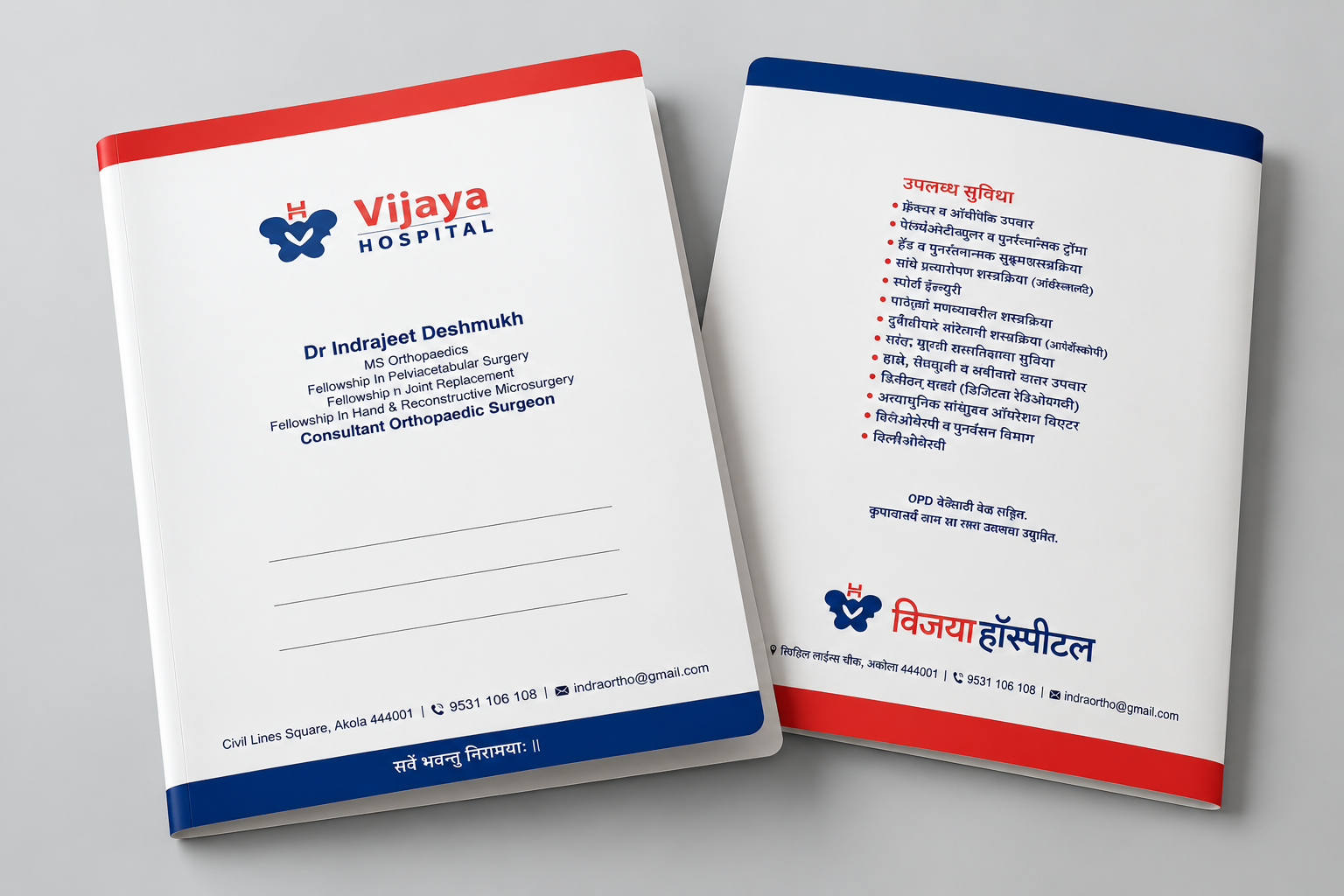 | Hospital Stationary PVC Files by Imagination are durable, stylish, and practical filing solutions designed for offices, schools, businesses, and personal use. View product → |
Frequently asked questions
What internal PVC file size suits A4 school records?
Specify about 240 × 320 mm of usable internal area for 210 × 297 mm A4 sheets, then check clearance for dividers, punched holes, laminated certificates and sleeves.
How do you choose PVC file spine width for school records?
Count the sheets, dividers and sleeves the file must hold, measure their compressed stack, and add clearance so the spine does not strain the closure or welds.
Which PVC file construction and closure suit daily school use?
Compare welded seams, material thickness, reinforced eyelets and closure types such as elastic bands, press studs, zips or hook-and-loop against the file’s handling frequency and retention period.
What should a school test before ordering custom PVC files?
Test the actual document stack, edge clearance, closure strength, seam quality, label readability, print adhesion and resistance to repeated opening, dust and storage.